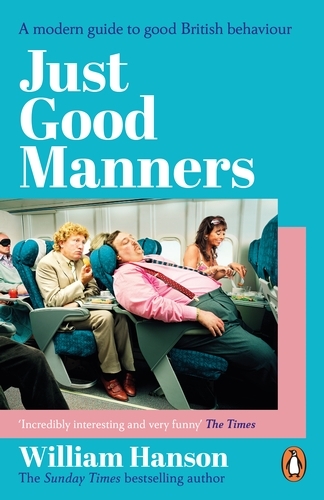
Just Good Manners
Wiliam Hanson (2024)
Penguin Random House, London.
284 pages, £8.99. ISBN: 978-1-804-95202-3
'Hey, John. What's
going
on? You wrote,
way back in February 2025, that, after 45 years of writing,
you would no longer be adding more stuff to your website.' 'OK, that is mostly
true, though more specifically I meant there would be no more
editions of my Updates on Life Issues. Nevertheless, I have
still been reading and keeping up to date with developments in
medicine and bioethics – old habits die hard.
As some sort of compromise, I have
continued to read general non-fiction, but without scribbling
in the margins or planning book reviews. Then last Christmas,
one of my children bought me Just Good Manners and it
has become the exception.
Why did he think I needed to read this book? Was I lacking in
this area or was it because I like a humorous read. That remains a moot
(and cheeky) point.
The book’s strapline neatly introduces it
as, A modern guide to good British behaviour. William Hanson
starts (p. 4) by defining the two key topics. ‘Manners are the
guiding principles of putting people at their ease, of not
embarrassing others, and of generally putting yourself
second.’ No
disagreements there. ‘Etiquette,
on the other hand, is a set of rules by which a society lives. How you become
well-mannered is (nine times out of ten) by following the
rules of etiquette.’ That
seems sensible too.
What follows is 280 or so pages fleshing
out these themes in a witty, even waggish, style. It ranges from how
to introduce yourself and other people by handshaking, hugging
and kissing. Entirely
practical. By
contrast, there is a section on how to meet and address the
Royal Family. Less
practical.
Somewhat strangely it has a huge 10 pages
of Index. However,
it failed to work for my test of 'soup' and how to eat it. However, there was one
takeaway lesson for me. It
concerned 'gravy.’ It
was rehearsed on p. 80 and again on p. 107. ‘Remember, gravy is
always ladled and never poured, even if the gravy boat has a
spout. That is
for the ladle to rest. The
gravy is ladled over the meat and nowhere else.’ Well, I never, I
never knew that! And
if, and when, the occasion arises, I hope I shall remember
that rule.
There is a short Appendix with samples of
how, and when, to write thank-you letters. Hanson’s examples
are overly flamboyant even to the point of embarrassment. For a dinner: ‘Thank
you so much indeed for such an elegant and seemingly
effortless dinner and crackling conversation last night.’ For a wedding: ‘We
both adored having you there to celebrate with us and are
looking forward to seeing you in a few weeks at the theatre.’
Yes, it is histrionic. I was also struck by
the easy homosexual stance of the book's author, William
Hanson. I had
previously never heard of him. However,
early on I noted some rather twee and camp remarks to be
confirmed by the introduction of his husband Mikey on the
wedding thank-you letter.
Overall, this is a niche book. Who needs all these
extra rules and layers of etiquette? Nevertheless, the
anecdotes are interesting, and the quibbles of behaviours are
amusing. However,
in summary, Hanson is correct.
We need to be ‘putting people at their ease, of not
embarrassing others, and of generally putting yourself second’
(p. 4). Indeed,
that is almost the Golden Rule, ‘Love your neighbour as
yourself’ (Leviticus 19: 18 and Matthew 23: 39).
This book is truly 'a modern guide', but sometimes the old
guides are the best.