The Boy, the Mole, the Fox and the Horse
Charlie Mackesy (2019)
Penguin Random House, London.
284 pages, £8.99. ISBN: 978-1-804-95202-3
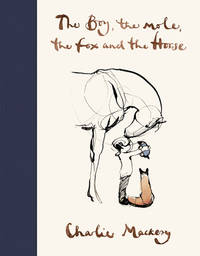
And now there is The Boy, the Mole, the Fox and the Horse (2019) by Charlie Mackesy. It too has achieved massive sales, becoming the UK's bestselling adult hardback book ever with over 2 million copies sold in the UK and over 10 million worldwide in over 55 different languages. In addition, it has dominated book charts, won numerous publishing prizes, and its film adaptation has gained BAFTA and Oscar awards and inspired a successful sequel, Always Remember (2025).
The Boy is a book with a message. It has been described as a story about finding hope, love and connection through friendship, kindness and vulnerability. It is a sweet tale told through conversations between its four characters and its bold, blotchy artwork. Mackesy himself says in the Introduction, ‘I hope this book encourages you, perhaps, to live courageously with more kindness for yourself and for others. And to ask for help when you need it – which is always a brave thing to do.'
How can such aspirations be anything other than admirable? Who would not want them? Yet here comes a massive stumbling block. How can these laudable virtues not just be approved in our brains, but also realised in our lives?
The root problem with this, and with other sorts of self-improvement books, is that they sound seductively nice and warm, but they easily verge into popular psychobabble which lacks solid and enduring answers. Enter the Christian foundation. For example, look at the so-called fruit of the Spirit in Galatians 5: 22-23. They are, ‘love, joy, peace, patience, kindness, goodness, faithfulness, gentleness and self-control. Against such things there is no law.’ What wonderful human qualities! At this point it may seem that the apostle Paul and Charles Mackesay are in accord. Yet really, they are worlds apart. Charles answers from an agnostic worldview – try your best, pull your socks up, turn over a new leaf. Paul answers from a Christian worldview – ask God to transform your character to be like that of Jesus Christ as both Saviour and Lord.
This Carolean-Pauline
difference is everything. Charles says the answers
come from within a man, Paul says they come from without a
man, from God.
None of this is new. Turn your back on
God and you will be in trouble. Read about that in
the first three chapters of Genesis. This agnostic
worldview is essentially man-made, a derived conduct without
any specifically coherent basis. By contrast, the
Christian answer is derived from a robust, biblical
framework. These
two worldviews are entirely conflicting.
And herein lies that
massive stumbling block.
The agnostic worldview, and this is Mackesay’s
position, can often appear to endorse and even instigate
that attractive Christian morality, such as those nine
fruits of the Spirit, but it is detached from the essential
spurs of Christian faith and divine energy. It is reminiscent of
the Enlightenment’s doomed attempt to replicate Christian
virtue without embracing Christian truth – a wanting the
fruits but without the roots. By contrast, the
Christian’s stance is unashamedly transcendent in origin and
spiritually energized in action. It is primarily
received, intensely personal, all-pervasive as a lifestyle,
and all-embracing as a worldview. Christian, never be
satisfied with second-best.
In conclusion, while
the themes and answers from The Boy are
warm-hearted, those from the Bible are whole-hearted. The former is
skin-deep, the latter is deep-seated. So again, Christian, never
be satisfied with second-best.
And
thank you, Charlie, for spotlighting that
all-important conflict.